
Bad strategy can sink a financial plan fast.
But a great plan can still break if the right things don’t get done at the right time.
A Roth conversion that never happened because no one circled back in December.
A forgotten RMD.
An old 401(k) sitting unmanaged because it wasn’t “urgent.”
A beneficiary designation from 15 years ago that no longer reflects reality.
None of these are complicated. They’re just easy to miss.
That’s the problem with a reactive approach to financial planning. You only deal with things when they become obvious, and by then, the window to handle them efficiently is often gone.
We built our Service Calendar to solve that exact problem.
Instead of asking, “What should we be doing right now?” we already know. Every part of your financial life: taxes, investments, retirement, and estate planning, is addressed at a specific time of year when it actually matters. It keeps us proactive, organized, and most importantly, ahead of problems.
It creates natural points throughout the year where we monitor your plan and make important decisions, not just review random numbers.
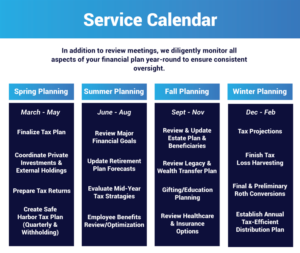
Spring Planning (March – May): Tax Season
Spring is one of the most important times of the year, and most people treat it like the finish line.
We treat it as a starting point.
Your tax return is the most detailed financial document you produce all year. It shows income sources, deductions, investment activity, and often highlights inefficiencies that weren’t obvious before.
During this period, we:
- Prepare and finalize your tax return
- Identify planning opportunities that came out of the return
- Coordinate any outside accounts or private investments
- Set or adjust quarterly payments and withholdings for the current year to avoid underpayment penalties
This is also when we fix things early.
If your income jumped, we adjust your tax strategy now, not in December when options are limited. If there were unexpected capital gains, we plan around them immediately. If something felt off about the return, we dig into it while it’s still fresh.
This is typically our most in-depth planning work of the year. We review the return in detail, and when it makes sense, we’ll meet to walk through it together and map out the next steps.
Summer Planning (June – August): Are We On Track?
By the time summer rolls around, we start to look towards the future.
This is where we step back and ask a simple question: Are we on track, or do we need to adjust?
During this phase, we focus on:
- Progress toward your long-term financial goals
- Updated retirement projections – When can you retire? How much can you safely spend?
- Mid-year tax strategy adjustments
- Reviewing employer benefits, compensation changes, and savings rates
This is one of the most commonly missed planning windows.
Most people wait until year-end to think about taxes or retirement. The problem is that by then, you’ve already earned most of your income, made most of your contributions, and lost flexibility.
Summer gives us time to make meaningful changes while there’s still time for them to matter.
Fall Planning (September – November): The Things People Put Off
Fall is where we shift gears.
This is less about taxes and investments and more about the parts of financial planning that tend to get pushed aside, yet are some of the most important.
We focus on:
- Reviewing and updating estate plans and beneficiary designations
- Evaluating legacy and wealth transfer strategies
- Planning for gifting and education funding
- Reviewing healthcare and insurance options ahead of open enrollment
This is where we see a lot of preventable mistakes.
Outdated beneficiaries.
Estate documents that don’t match current wishes (or none at all).
Missed gifting opportunities that could have reduced future tax burdens.
None of these feel urgent day-to-day, which is exactly why they don’t get done. The Service Calendar forces them into the conversation at the right time.
The goal here is to make sure everything is aligned with what you actually want long term.
Winter Planning (December – February): Where It All Comes Together
Winter is where everything comes together.
At this point, we have a clear picture of your full-year income, investment activity, and tax situation. That allows us to make precise, informed decisions before the year closes.
Our focus here includes:
- Running detailed tax projections
- Executing tax-loss harvesting where appropriate
- Finalizing Roth conversion strategies
- Building or refining distribution plans for the upcoming year
This is where proactive planning shows its value.
Instead of scrambling in late December trying to “do something for taxes,” we’re making calculated moves based on a full year of monitoring and planning.
For some clients, especially those with more complex tax situations, this may involve an additional year-end or early-year meeting to finalize decisions before filing season begins again.
How This Actually Works Day-to-Day
The Service Calendar isn’t built around meetings, it’s built around plan timing.
We’re continuously monitoring your situation in the background, and when something comes up that requires a decision, that’s when we connect. For some clients, that may mean a few structured conversations throughout the year. For others, it may be less.
The goal isn’t to hit a meeting quota, it’s to make sure every conversation actually matters.
Everything else is happening in the background.
We are continuously monitoring your accounts, tracking changes, and adjusting strategies throughout the year. If something comes up: a job change, a large purchase, a market event, a tax question, you don’t have to wait for the next scheduled meeting.
You can call.
You can email.
You can stop by the office.
That ongoing access is just as important as the structured calendar.
Final Thoughts
Anyone can build a financial plan once.
Very few people execute it consistently over time.
The Service Calendar is what closes that gap.
No more asking yourself, “What is my advisor actually doing for me?”
The Service Calendar creates structure without being rigid.
It keeps us proactive instead of reactive.
And it ensures that the important things, the ones that are easy to miss, actually get done.
That’s how we help clients stay organized, make better decisions, and move forward with confidence.
If you want a plan that’s actually monitored and acted on throughout the year, please reach out.
– Clint Kraft
Founder and Financial Advisor, Kraft Capital